Vintage Millefiori Murano Art Blue Glass Human Face Opalescent White Bead Necklace
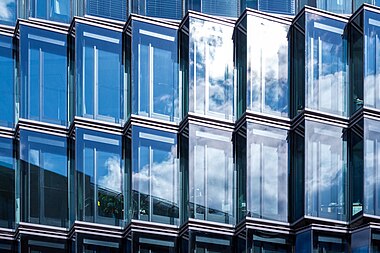
Drinking glass is a non-crystalline, ofttimes transparent amorphous solid, that has widespread applied, technological, and decorative use in, for example, window panes, tableware, and optics. Glass is most often formed by rapid cooling (quenching) of the molten class; some glasses such every bit volcanic glass are naturally occurring. The near familiar, and historically the oldest, types of manufactured glass are "silicate spectacles" based on the chemic compound silica (silicon dioxide, or quartz), the master constituent of sand. Soda-lime glass, containing effectually seventy% silica, accounts for around xc% of manufactured glass. The term drinking glass, in popular usage, is often used to refer only to this type of material, although silica-gratis spectacles oft take desirable properties for applications in mod communications engineering science. Some objects, such as drinking glasses and eyeglasses, are so ordinarily made of silicate-based glass that they are simply called by the name of the fabric.
Although brittle, buried silicate drinking glass will survive for very long periods if not disturbed, and many examples of glass fragments exist from early glass-making cultures. Archaeological evidence suggests drinking glass-making dates back to at least 3,600 BC in Mesopotamia, Arab republic of egypt, or Syria. The earliest known glass objects were chaplet, possibly created accidentally during metalworking or the product of faience. Due to its ease of formability into any shape, glass has been traditionally used for vessels, such as bowls, vases, bottles, jars and drinking spectacles. In its most solid forms, it has also been used for paperweights and marbles. Drinking glass tin exist coloured by adding metal salts or painted and printed every bit enamelled glass. The refractive, cogitating and transmission backdrop of glass make glass suitable for manufacturing optical lenses, prisms, and optoelectronics materials. Extruded drinking glass fibres have application every bit optical fibres in communications networks, thermal insulating material when disordered as glass wool and so as to trap air, or in glass-fibre reinforced plastic (fibreglass).
Microscopic structure

The amorphous structure of glassy silica (SiO2) in 2 dimensions. No long-range order is nowadays, although there is local ordering with respect to the tetrahedral arrangement of oxygen (O) atoms around the silicon (Si) atoms.

Microscopically, a unmarried crystal has atoms in a most-perfect periodic organisation; a polycrystal is equanimous of many microscopic crystals; and an amorphous solid such as drinking glass has no periodic arrangement even microscopically.
The standard definition of a drinking glass (or vitreous solid) is a solid formed by rapid melt quenching.[1] [ii] [three] [iv] However, the term "glass" is often defined in a broader sense, to describe any non-crystalline (amorphous) solid that exhibits a glass transition when heated towards the liquid state.[4] [5]
Glass is an amorphous solid. Although the atomic-scale construction of glass shares characteristics of the structure of a supercooled liquid, glass exhibits all the mechanical backdrop of a solid.[6] [7] [8] As in other baggy solids, the atomic construction of a glass lacks the long-range periodicity observed in crystalline solids. Due to chemical bonding constraints, glasses do possess a high degree of curt-range order with respect to local atomic polyhedra.[9] The notion that drinking glass flows to an appreciable extent over extended periods of time is not supported by empirical research or theoretical assay (see viscosity in solids). Laboratory measurements of room temperature glass flow exercise testify a movement consistent with a cloth viscosity on the guild of 1017–xeighteen Pa s.[5] [10]
Formation from a supercooled liquid
Unsolved problem in physics :
What is the nature of the transition between a fluid or regular solid and a glassy phase? "The deepest and most interesting unsolved problem in solid state theory is probably the theory of the nature of drinking glass and the drinking glass transition." —P.W. Anderson[eleven]
For cook quenching, if the cooling is sufficiently rapid (relative to the characteristic crystallization time) then crystallization is prevented and instead the disordered atomic configuration of the supercooled liquid is frozen into the solid land at Tg. The trend for a material to grade a drinking glass while quenched is chosen glass-forming ability. This power can be predicted by the rigidity theory.[12] Generally, a glass exists in a structurally metastable state with respect to its crystalline form, although in sure circumstances, for example in atactic polymers, at that place is no crystalline counterpart of the baggy stage.[13]
Glass is sometimes considered to be a liquid due to its lack of a first-order phase transition[7] [14] where certain thermodynamic variables such every bit volume, entropy and enthalpy are discontinuous through the glass transition range. The glass transition may be described as analogous to a second-order stage transition where the intensive thermodynamic variables such as the thermal expansivity and heat capacity are discontinuous, however this is incorrect.[ii] The equilibrium theory of stage transformations do non agree for glass, and hence the drinking glass transition cannot be classed as one of the classical equilibrium phase transformations in solids.[iv] [5] Furthermore, it does not describe the temperature dependence of Tg upon heating rate, as establish in differential scanning calorimetry.
Occurrence in nature
Drinking glass can form naturally from volcanic magma. Obsidian is a common volcanic glass with high silica (SiOtwo) content formed when felsic lava extruded from a volcano cools speedily.[15] Impactite is a form of glass formed by the bear upon of a meteorite, where Moldavite (plant in key and eastern Europe), and Libyan desert glass (found in areas in the eastern Sahara, the deserts of eastern Libya and western Arab republic of egypt) are notable examples.[16] Vitrification of quartz tin can as well occur when lightning strikes sand, forming hollow, branching rootlike structures called fulgurites.[17] Trinitite is a burnished balance formed from the desert floor sand at the Trinity nuclear bomb exam site.[xviii] Edeowie drinking glass, found in Southward Australia, is proposed to originate from Pleistocene grassland fires, lightning strikes, or hypervelocity impact by one or several asteroids or comets.[19]


History
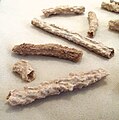
Naturally occurring obsidian glass was used by Rock Historic period societies as it fractures forth very abrupt edges, making it platonic for cut tools and weapons.[20] [21] Glassmaking dates back at least 6000 years, long earlier humans had discovered how to smelt iron.[20] Archaeological show suggests that the first true constructed glass was made in Lebanon and the coastal n Syrian arab republic, Mesopotamia or ancient Arab republic of egypt.[22] [23] The earliest known glass objects, of the mid-third millennium BC, were beads, perhaps initially created as adventitious by-products of metalworking (slags) or during the production of faience, a pre-drinking glass vitreous fabric made by a procedure similar to glazing.[24] Early glass was rarely transparent and often contained impurities and imperfections,[xx] and is technically faience rather than true drinking glass, which did not announced until the 15th century BC.[25] However, scarlet-orange glass beads excavated from the Indus Valley Civilization dated before 1700 BC (possibly as early as 1900 BC) predate sustained glass production, which appeared around 1600 BC in Mesopotamia and 1500 BC in Egypt.[26] [27] During the Belatedly Bronze Age in that location was a rapid growth in glassmaking technology in Egypt and Western Asia.[22] Archaeological finds from this flow include coloured glass ingots, vessels, and beads.[22] [28] Much early on drinking glass product relied on grinding techniques borrowed from stoneworking, such as grinding and etching glass in a cold state.[29]
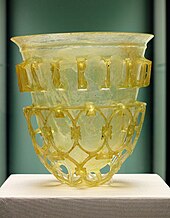
The term drinking glass adult in the tardily Roman Empire. It was in the Roman glassmaking centre at Trier (located in current-day Germany) that the late-Latin term glesum originated, probably from a Germanic word for a transparent, lustrous substance.[30] Drinking glass objects have been recovered across the Roman Empire [31] in domestic, funerary,[32] and industrial contexts,[33] besides as trade items in marketplaces in distant provinces.[34] [35] Examples of Roman glass have been found outside of the former Roman Empire in Cathay,[36] the Baltics, the Middle East, and India.[37] The Romans perfected cameo glass, produced by etching and etching through fused layers of dissimilar colours to produce a design in relief on the glass object.[38]
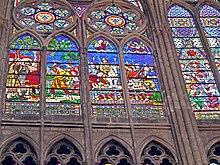
Windows in the choir of the Basilica of Saint Denis, one of the earliest uses of extensive areas of drinking glass (early 13th-century architecture with restored glass of the 19th century)
In post-classical W Africa, Benin was a manufacturer of glass and glass beads.[39] Glass was used extensively in Europe during the Middle Ages. Anglo-Saxon glass has been establish beyond England during archaeological excavations of both settlement and cemetery sites.[40] From the 10th century onwards, drinking glass was employed in stained drinking glass windows of churches and cathedrals, with famous examples at Chartres Cathedral and the Basilica of Saint Denis. By the 14th century, architects were designing buildings with walls of stained glass such equally Sainte-Chapelle, Paris, (1203–1248) and the East end of Gloucester Cathedral. With the change in architectural manner during the Renaissance catamenia in Europe, the use of large stained glass windows became much less prevalent,[41] although stained drinking glass had a major revival with Gothic Revival architecture in the 19th century.[42]
During the 13th century, the island of Murano, Venice, became a heart for glass making, building on medieval techniques to produce colourful ornamental pieces in big quantities.[38] Murano drinking glass makers developed the exceptionally clear colourless drinking glass cristallo, and so called for its resemblance to natural crystal, which was extensively used for windows, mirrors, ships' lanterns, and lenses.[20] In the 13th, 14th, and 15th centuries, enamelling and gilding on drinking glass vessels was perfected in Egypt and Syria.[43] Towards the stop of the 17th century, Bohemia became an important region for glass production, remaining and then until the showtime of the 20th century. Past the 17th century, drinking glass in the Venetian tradition was as well beingness produced in England. In virtually 1675, George Ravenscroft invented pb crystal glass, with cut drinking glass becoming fashionable in the 18th century.[38] Ornamental glass objects became an important art medium during the Fine art Nouveau period in the late 19th century.[38]
Throughout the 20th century, new mass production techniques led to widespread availability of glass in much larger amounts, making information technology practical every bit a building material and enabling new applications of glass.[44] In the 1920s a mould-etch procedure was developed, in which art was etched straight into the mould, so that each cast slice emerged from the mould with the prototype already on the surface of the glass. This reduced manufacturing costs and, combined with a wider use of coloured glass, led to cheap glassware in the 1930s, which later on became known equally Depression drinking glass.[45] In the 1950s, Pilkington Bros., England, developed the bladder glass process, producing high-quality distortion-gratis apartment sheets of glass by floating on molten tin.[20] Modern multi-story buildings are frequently constructed with drapery walls made well-nigh entirely of glass.[46] Laminated drinking glass has been widely practical to vehicles for windscreens.[47] Optical glass for spectacles has been used since the Middle Ages.[48] The product of lenses has become increasingly good, aiding astronomers[49] as well every bit having other awarding in medicine and science.[50] Glass is too employed as the aperture cover in many solar energy collectors.[51]
In the 21st century, glass manufacturers accept adult unlike brands of chemically strengthened glass for widespread application in touchscreens for smartphones, tablet computers, and many other types of information appliances. These include Gorilla glass, developed and manufactured past Corning, AGC Inc.'s Dragontrail and Schott AG's Xensation.[52] [53] [54]
Physical backdrop
Optical
Glass is in widespread use in optical systems due to its power to refract, reflect, and transmit light following geometrical eyes. The near common and oldest applications of glass in optics are as lenses, windows, mirrors, and prisms.[55] The key optical properties refractive index, dispersion, and manual, of drinking glass are strongly dependent on chemic composition and, to a bottom degree, its thermal history.[55] Optical glass typically has a refractive index of i.4 to two.4, and an Abbe number (which characterises dispersion) of 15 to 100.[55] Refractive index may be modified by high-density (refractive alphabetize increases) or low-density (refractive alphabetize decreases) additives.[56]
Glass transparency results from the absence of grain boundaries which diffusely scatter calorie-free in polycrystalline materials.[57] Semi-opacity due to crystallization may be induced in many glasses past maintaining them for a long catamenia at a temperature but insufficient to cause fusion. In this way, the crystalline, devitrified fabric, known as Réaumur'due south glass porcelain is produced.[43] [58] Although generally transparent to visible light, glasses may be opaque to other wavelengths of lite. While silicate spectacles are generally opaque to infrared wavelengths with a manual cut-off at four μm, heavy-metal fluoride and chalcogenide spectacles are transparent to infrared wavelengths of up to vii and up to 18 μm, respectively.[59] The addition of metallic oxides results in different coloured glasses as the metallic ions will blot wavelengths of light corresponding to specific colours.[59]
Other
In the manufacturing procedure, glasses can be poured, formed, extruded and moulded into forms ranging from flat sheets to highly intricate shapes.[lx] The finished production is breakable and volition fracture, unless laminated or tempered to enhance durability.[61] [62] Glass is typically inert, resistant to chemical assail, and can mostly withstand the activity of water, making information technology an ideal textile for the manufacture of containers for foodstuffs and most chemicals.[xx] [63] [64] Still, although commonly highly resistant to chemical attack, glass will corrode or deliquesce under some conditions.[63] [65] The materials that brand up a item glass composition take an upshot on how quickly the drinking glass corrodes. Spectacles containing a high proportion of alkali or alkaline globe elements are more susceptible to corrosion than other drinking glass compositions.[66] [67]
The density of glass varies with chemical composition with values ranging from two.2 grams per cubic centimetre (two,200 kg/mthree) for fused silica to seven.two grams per cubic centimetre (vii,200 kg/k3) for dense flint glass.[68] Glass is stronger than well-nigh metals, with a theoretical tensile force for pure, flawless glass estimated at xiv gigapascals (2,000,000 psi) to 35 gigapascals (5,100,000 psi) due to its ability to undergo reversible compression without fracture. Still, the presence of scratches, bubbles, and other microscopic flaws lead to a typical range of 14 megapascals (ii,000 psi) to 175 megapascals (25,400 psi) in near commercial glasses.[59] Several processes such as toughening can increase the strength of drinking glass.[69] Carefully drawn flawless glass fibres can be produced with force of up to eleven.5 gigapascals (1,670,000 psi).[59]
Reputed period
The observation that old windows are sometimes found to be thicker at the bottom than at the top is frequently offered equally supporting evidence for the view that glass flows over a timescale of centuries, the assumption being that the drinking glass has exhibited the liquid property of flowing from one shape to some other.[seventy] This assumption is wrong, as once solidified, glass stops flowing. The sags and ripples observed in old glass were already there the twenty-four hours information technology was fabricated; manufacturing processes used in the past produced sheets with imperfect surfaces and non-uniform thickness.[7] (The near-perfect float glass used today just became widespread in the 1960s.)
Types
Silicate

Quartz sand (silica) is the main raw cloth in commercial glass production
Silicon dioxide (SiO2) is a common central constituent of glass. Fused quartz is a glass made from chemically-pure silica.[67] Information technology has very low thermal expansion and splendid resistance to thermal shock, being able to survive immersion in water while red hot, resists high temperatures (1000–1500 °C) and chemical weathering, and is very hard. It is also transparent to a wider spectral range than ordinary glass, extending from the visible further into both the UV and IR ranges, and is sometimes used where transparency to these wavelengths is necessary. Fused quartz is used for high-temperature applications such every bit furnace tubes, lighting tubes, melting crucibles, etc.[71] However, its high melting temperature (1723 °C) and viscosity arrive difficult to work with. Therefore, normally, other substances (fluxes) are added to lower the melting temperature and simplify glass processing.[72]
Soda-lime
Sodium carbonate (Na2COiii, "soda") is a common additive and acts to lower the drinking glass-transition temperature. However, sodium silicate is water soluble, so lime (CaO, calcium oxide, generally obtained from limestone), some magnesium oxide (MgO) and aluminium oxide (Al2O3) are other common components added to improve chemical durability. Soda-lime spectacles (Na2O) + lime (CaO) + magnesia (MgO) + alumina (Al2O3) account for over 75% of manufactured glass, containing nearly 70 to 74% silica past weight.[67] [73] Soda-lime-silicate glass is transparent, easily formed, and most suitable for window glass and tableware.[74] However, it has a high thermal expansion and poor resistance to rut.[74] Soda-lime glass is typically used for windows, bottles, lite bulbs, and jars.[72]
Borosilicate

Borosilicate glasses (e.g. Pyrex, Duran) typically contain v–13% boron trioxide (B2O3).[72] Borosilicate glasses have fairly low coefficients of thermal expansion (7740 Pyrex CTE is 3.25×10 −six /°C[75] as compared to about 9×10 −6 /°C for a typical soda-lime glass[76]). They are, therefore, less bailiwick to stress caused past thermal expansion and thus less vulnerable to great from thermal daze. They are commonly used for eastward.one thousand. labware, household cookware, and sealed beam car head lamps.[72]
Lead
The improver of pb(2) oxide into silicate glass lowers melting betoken and viscosity of the melt.[77] The high density of lead glass (silica + lead oxide (PbO) + potassium oxide (K2O) + soda (Na2O) + zinc oxide (ZnO) + alumina) results in a high electron density, and hence high refractive index, making the look of glassware more brilliant and causing noticeably more specular reflection and increased optical dispersion.[67] [78] Lead drinking glass has a loftier elasticity, making the glassware more workable and giving ascent to a clear "ring" sound when struck. Even so, atomic number 82 glass cannot withstand high temperatures well.[71] Lead oxide also facilitates solubility of other metallic oxides and is used in colored glass. The viscosity subtract of lead glass cook is very significant (roughly 100 times in comparing with soda glass); this allows easier removal of bubbles and working at lower temperatures, hence its frequent use as an additive in vitreous enamels and glass solders. The high ionic radius of the Leadii+ ion renders it highly immobile and hinders the motility of other ions; lead glasses therefore have high electrical resistance, about two orders of magnitude higher than soda-lime glass (ten8.5 vs 10half-dozen.5 Ω⋅cm, DC at 250 °C).[79]
Aluminosilicate
Aluminosilicate glass typically contains 5-10% alumina (Al2Oiii). Aluminosilicate glass tends to be more difficult to melt and shape compared to borosilicate compositions, but has excellent thermal resistance and durability.[72] Aluminosilicate glass is extensively used for fiberglass,[80] used for making glass-reinforced plastics (boats, fishing rods, etc.), top-of-stove cookware, and halogen bulb glass.[71] [72]
Other oxide additives
The improver of barium also increases the refractive alphabetize. Thorium oxide gives glass a high refractive index and low dispersion and was formerly used in producing high-quality lenses, merely due to its radioactive decay has been replaced by lanthanum oxide in mod eyeglasses.[81] Iron can be incorporated into glass to absorb infrared radiations, for example in oestrus-absorbing filters for movie projectors, while cerium(IV) oxide can exist used for glass that absorbs ultraviolet wavelengths.[82] Fluorine lowers the dielectric abiding of glass. Fluorine is highly electronegative and lowers the polarizability of the textile. Fluoride silicate spectacles are used in manufacture of integrated circuits as an insulator.[83]
Glass-ceramics

Glass-ceramic materials contain both non-crystalline glass and crystalline ceramic phases. They are formed by controlled nucleation and partial crystallisation of a base glass by rut handling.[84] Crystalline grains are ofttimes embedded within a non-crystalline intergranular phase of grain boundaries. Glass-ceramics exhibit advantageous thermal, chemical, biological, and dielectric properties as compared to metals or organic polymers.[84]
The almost commercially important belongings of glass-ceramics is their imperviousness to thermal shock. Thus, glass-ceramics have get extremely useful for countertop cooking and industrial processes. The negative thermal expansion coefficient (CTE) of the crystalline ceramic phase tin be counterbalanced with the positive CTE of the glassy phase. At a sure point (~seventy% crystalline) the drinking glass-ceramic has a net CTE near nil. This type of drinking glass-ceramic exhibits excellent mechanical properties and can sustain repeated and quick temperature changes upward to 1000 °C.[85] [84]
Fibreglass
Fibreglass (too called glass fibre reinforced plastic, GRP) is a blended fabric made past reinforcing a plastic resin with drinking glass fibres. Information technology is made by melting drinking glass and stretching the glass into fibres. These fibres are woven together into a cloth and left to set in a plastic resin.[86] [87] [88] Fibreglass has the properties of existence lightweight and corrosion resistant, and is a good insulator enabling its apply equally building insulation material and for electronic housing for consumer products. Fibreglass was originally used in the United Kingdom and United States during World War II to industry radomes. Uses of fibreglass include building and construction materials, boat hulls, car body parts, and aerospace composite materials.[89] [86] [88]
Glass-fibre wool is an excellent thermal and audio insulation material, unremarkably used in buildings (e.g. attic and cavity wall insulation), and plumbing (e.1000. pipe insulation), and soundproofing.[89] It is produced by forcing molten glass through a fine mesh past centripetal force, and breaking the extruded glass fibres into short lengths using a stream of high-velocity air. The fibres are bonded with an adhesive spray and the resulting wool mat is cut and packed in rolls or panels.[59]
Non-silicate

Also mutual silica-based glasses many other inorganic and organic materials may likewise form glasses, including metals, aluminates, phosphates, borates, chalcogenides, fluorides, germanates (glasses based on GeO2), tellurites (spectacles based on TeO2), antimonates (glasses based on Sb2Oiii), arsenates (glasses based on As2O3), titanates (glasses based on TiO2), tantalates (spectacles based on Ta2Ov), nitrates, carbonates, plastics, acrylic, and many other substances.[5] Some of these glasses (eastward.chiliad. Germanium dioxide (GeOii, Germania), in many respects a structural counterpart of silica, fluoride, aluminate, phosphate, borate, and chalcogenide spectacles) take physico-chemic properties useful for their application in fibre-optic waveguides in advice networks and other specialized technological applications.[91] [92]
Silica-free glasses may often have poor drinking glass forming tendencies. Novel techniques, including containerless processing by aerodynamic levitation (cooling the melt whilst it floats on a gas stream) or splat quenching (pressing the melt betwixt 2 metal anvils or rollers), may be used increment cooling rate, or reduce crystal nucleation triggers.[93] [94] [95]
Amorphous metals

Samples of amorphous metallic, with millimeter scale
In the past, pocket-size batches of amorphous metals with loftier area configurations (ribbons, wires, films, etc.) have been produced through the implementation of extremely rapid rates of cooling. Amorphous metallic wires have been produced by sputtering molten metal onto a spinning metal disk. More than recently a number of alloys have been produced in layers with thickness exceeding one millimeter. These are known as bulk metallic glasses (BMG). Liquidmetal Technologies sell a number of zirconium-based BMGs. Batches of baggy steel have too been produced that demonstrate mechanical properties far exceeding those found in conventional steel alloys.[96] [97] [98]
Experimental evidence indicates that the system Al-Iron-Si may undergo a kickoff-order transition to an baggy class (dubbed "q-glass") on rapid cooling from the cook. Transmission electron microscopy (TEM) images indicate that q-glass nucleates from the cook as discrete particles with a uniform spherical growth in all directions. While x-ray diffraction reveals the isotropic nature of q-drinking glass, a nucleation barrier exists implying an interfacial discontinuity (or internal surface) between the glass and cook phases.[99] [100]
Polymers
Important polymer glasses include amorphous and glassy pharmaceutical compounds. These are useful because the solubility of the compound is profoundly increased when it is amorphous compared to the same crystalline limerick. Many emerging pharmaceuticals are practically insoluble in their crystalline forms.[101] Many polymer thermoplastics familiar from everyday apply are spectacles. For many applications, like glass bottles or eyewear, polymer spectacles (acrylic glass, polycarbonate or polyethylene terephthalate) are a lighter culling to traditional glass.[102]
Molecular liquids and molten salts
Molecular liquids, electrolytes, molten salts, and aqueous solutions are mixtures of different molecules or ions that do non form a covalent network but interact only through weak van der Waals forces or through transient hydrogen bonds. In a mixture of three or more than ionic species of unlike size and shape, crystallization can be then difficult that the liquid tin can easily be supercooled into a glass.[103] [104] Examples include LiCl:RH2O (a solution of lithium chloride salt and h2o molecules) in the composition range 4<R<8.[105] sugar glass,[106] or Ca0.4G0.6(NO3)1.iv.[107] Glass electrolytes in the form of Ba-doped Li-drinking glass and Ba-doped Na-drinking glass accept been proposed as solutions to problems identified with organic liquid electrolytes used in modern lithium-ion battery cells.[108]
Production
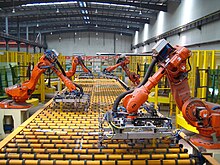
Robotized bladder drinking glass unloading
Following the glass batch grooming and mixing, the raw materials are transported to the furnace. Soda-lime glass for mass product is melted in glass melting furnaces. Smaller scale furnaces for specialty spectacles include electric melters, pot furnaces, and day tanks.[73] Afterward melting, homogenization and refining (removal of bubbles), the glass is formed. Apartment glass for windows and similar applications is formed by the float glass process, adult betwixt 1953 and 1957 by Sir Alastair Pilkington and Kenneth Bickerstaff of the United kingdom's Pilkington Brothers, who created a continuous ribbon of drinking glass using a molten tin can bath on which the molten drinking glass flows unhindered under the influence of gravity. The top surface of the drinking glass is subjected to nitrogen nether pressure level to obtain a polished finish.[109] Container glass for common bottles and jars is formed by blowing and pressing methods.[110] This glass is frequently slightly modified chemically (with more alumina and calcium oxide) for greater water resistance.[111]

Once the desired form is obtained, drinking glass is usually annealed for the removal of stresses and to increment the glass's hardness and durability.[112] Surface treatments, coatings or lamination may follow to ameliorate the chemical durability (drinking glass container coatings, glass container internal handling), strength (toughened glass, impenetrable glass, windshields[113]), or optical properties (insulated glazing, anti-cogitating coating).[114]
New chemical glass compositions or new treatment techniques can be initially investigated in small-calibration laboratory experiments. The raw materials for laboratory-scale drinking glass melts are oft different from those used in mass production considering the cost factor has a low priority. In the laboratory mostly pure chemicals are used. Care must exist taken that the raw materials have not reacted with moisture or other chemicals in the environment (such as alkali or element of group ii oxides and hydroxides, or boron oxide), or that the impurities are quantified (loss on ignition).[115] Evaporation losses during drinking glass melting should exist considered during the selection of the raw materials, e.g., sodium selenite may exist preferred over easily evaporating selenium dioxide (SeO2). Also, more readily reacting raw materials may be preferred over relatively inert ones, such as aluminum hydroxide (Al(OH)iii) over alumina (Al2O3). Unremarkably, the melts are carried out in platinum crucibles to reduce contamination from the crucible fabric. Glass homogeneity is achieved by homogenizing the raw materials mixture (glass batch), by stirring the melt, and past burdensome and re-melting the kickoff cook. The obtained glass is commonly annealed to forbid breakage during processing.[115] [116]
Colour
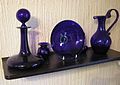
Color in glass may be obtained past addition of homogenously distributed electrically charged ions (or colour centres). While ordinary soda-lime glass appears colourless in thin section, iron(II) oxide (FeO) impurities produce a green tint in thick sections.[117] Manganese dioxide (MnOii), which gives glass a purple colour, may be added to remove the green tint given past FeO.[118] FeO and chromium(III) oxide (Cr2O3) additives are used in the production of green bottles.[117] Atomic number 26 (III) oxide, on the other-hand, produces yellowish or yellow-brown glass.[119] Depression concentrations (0.025 to 0.1%) of cobalt oxide (CoO) produces rich, deep blue cobalt drinking glass.[120] Chromium is a very powerful colourising amanuensis, yielding dark green.[121] Sulphur combined with carbon and iron salts produces amber glass ranging from yellowish to almost black.[122] A glass melt tin can also acquire an amber colour from a reducing combustion temper.[123] Cadmium sulfide produces royal red, and combined with selenium tin produce shades of yellow, orange, and crimson.[117] [119] The additive Copper(Ii) oxide (CuO) produces a turquoise colour in glass, in dissimilarity to Copper(I) oxide (Cu2O) which gives a dull brown-ruddy colour.[124]
-
-

Red glass bottle with yellow glass overlay
-
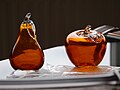
Amber-coloured drinking glass
-
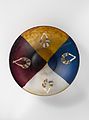
Iv-color Roman drinking glass bowl, manufactured circa 1st century B.C.
Uses
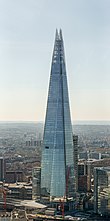
Architecture and windows
Soda-lime sheet glass is typically used as transparent glazing fabric, typically as windows in external walls of buildings. Float or rolled sheet drinking glass products is cutting to size either past scoring and snapping the material, light amplification by stimulated emission of radiation cutting, water jets, or diamond bladed saw. The glass may be thermally or chemically tempered (strengthened) for rubber and aptitude or curved during heating. Surface coatings may be added for specific functions such equally scratch resistance, blocking specific wavelengths of light (eastward.chiliad. infrared or ultraviolet), clay-repellence (e.one thousand. self-cleaning drinking glass), or switchable electrochromic coatings.[125]
Structural glazing systems correspond ane of the most pregnant architectural innovations of mod times, where drinking glass buildings now often boss skylines of many modernistic cities.[126] These systems apply stainless steel fittings countersunk into recesses in the corners of the glass panels allowing strengthened panes to appear unsupported creating a flush exterior.[126] Structural glazing systems have their roots in iron and glass conservatories of the nineteenth century[127]
Tableware
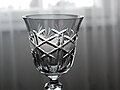
Glass is an essential component of tableware and is typically used for water, beer and wine drinking glasses.[fifty] Wine glasses are typically stemware, i.e. goblets formed from a bowl, stem, and human foot. Crystal or Lead crystal glass may be cut and polished to produce decorative drinking glasses with gleaming facets.[128] [129] Other uses of glass in tableware include decanters, jugs, plates, and bowls.[l]
-

Wine glasses and other glass tableware
-
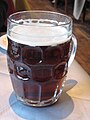
Dimpled glass beer pint jug
-
-

Packaging
The inert and impermeable nature of glass makes it a stable and widely used fabric for food and beverage packaging as drinking glass bottles and jars. Most container glass is soda-lime glass, produced by bravado and pressing techniques. Container drinking glass has a lower magnesium oxide and sodium oxide content than flat glass, and a higher silica, calcium oxide, and aluminum oxide content.[130] Its higher content of h2o-insoluble oxides imparts slightly college chemical durability against h2o, which is advantageous for storing beverages and food. Glass packaging is sustainable, readily recycled, reusable and refillable.[131]
For electronics applications, glass can be used every bit a substrate in the manufacture of integrated passive devices, thin-flick bulk audio-visual resonators, and as a hermetic sealing fabric in device packaging,[132] [133] including very thin solely glass based encapsulation of integrated circuits and other semiconductors in high manufacturing volumes.[134]
Laboratories
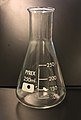
Glass is an of import textile in scientific laboratories for the industry of experimental apparatus because information technology is relatively cheap, readily formed into required shapes for experiment, easy to keep clean, can withstand heat and cold handling, is generally non-reactive with many reagents, and its transparency allows for the observation of chemic reactions and processes.[135] [136] Laboratory glassware applications include flasks, petri dishes, test tubes, pipettes, graduated cylinders, drinking glass lined metallic containers for chemical processing, fractionation columns, glass pipes, Schlenk lines, gauges, and thermometers.[137] [135] Although most standard laboratory glassware has been mass-produced since the 1920s, scientists still utilise skilled glassblowers to manufacture bespoke glass apparatus for their experimental requirements.[138]
-

A Vigreux cavalcade in a laboratory setup
-

-
Eyes
Glass is a ubiquitous fabric in optics by virtue of its ability to refract, reverberate, and transmit light. These and other optical properties tin exist controlled past varying chemical compositions, thermal treatment, and manufacturing techniques. The many applications of glass in optics includes spectacles for eyesight correction, imaging optics (due east.g. lenses and mirrors in telescopes, microscopes, and cameras), fibre eyes in telecommunications technology, and integrated optics. Microlenses and gradient-index optics (where the refractive index is non-uniform) find awarding in e.g. reading optical discs, laser printers, photocopiers, and laser diodes.[55]
Art

Part of German stained glass panel of 1444 with the Visitation; pot metal coloured glass of diverse colours, including white drinking glass, blackness vitreous paint, yellowish silver stain, and the "olive-green" parts are enamel. The plant patterns in the red heaven are formed by scratching abroad black paint from the red glass before firing. A restored console with new lead cames.
Glass as art dates to least 1300 BC shown as an example of natural glass found in Tutankhamun's pectoral, [139] which too contained vitreous enamel, that is to say, melted coloured glass used on a metal backing. Enamelled glass, the ornamentation of glass vessels with coloured glass paints, has existed since 1300 BC,[140] and was prominent in the early 20th century with Art Nouveau glass and that of the Business firm of Fabergé in St. Petersburg, Russian federation. Both techniques were used in stained drinking glass, which reached its height roughly from 1000 to 1550, before a revival in the 19th century.
The 19th century saw a revival in ancient glass-making techniques including cameo glass, achieved for the outset time since the Roman Empire, initially mostly for pieces in a neo-classical style. The Art Nouveau movement fabricated great employ of drinking glass, with René Lalique, Émile Gallé, and Daum of Nancy in the showtime French wave of the movement, producing coloured vases and similar pieces, oft in cameo glass or in lustre drinking glass techniques.[141]
Louis Condolement Tiffany in America specialized in stained glass, both secular and religious, in panels and his famous lamps. The early 20th-century saw the large-calibration factory production of drinking glass art past firms such as Waterford and Lalique. Small studios may mitt-produce drinking glass artworks. Techniques for producing glass fine art include bravado, kiln-casting, fusing, slumping, pâte de verre, flame-working, hot-sculpting and cold-working. Common cold work includes traditional stained glass piece of work and other methods of shaping glass at room temperature. Objects made out of glass include vessels, paperweights, marbles, chaplet, sculptures and installation fine art.[142]
-

Émile Gallé, Marquetry glass vase with clematis flowers (1890-1900)
-

-

-

A glass sculpture past Dale Chihuly, "The Dominicus" at the "Gardens of Glass" exhibition in Kew Gardens, London
-
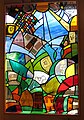
Modernistic stained drinking glass window
See also
- Fire drinking glass
- Flexible drinking glass
- Kimberley points
- Prince Rupert's drop
- Smart drinking glass
References
- ^ ASTM definition of glass from 1945
- ^ a b Zallen, R. (1983). The Physics of Amorphous Solids. New York: John Wiley. pp. 1–32. ISBN978-0-471-01968-8.
- ^ Cusack, Northward.E. (1987). The physics of structurally matted matter: an introduction. Adam Hilger in association with the Academy of Sussex press. p. thirteen. ISBN978-0-85274-829-9.
- ^ a b c Scholze, Horst (1991). Drinking glass – Nature, Structure, and Properties. Springer. pp. iii–5. ISBN978-0-387-97396-8.
- ^ a b c d Elliot, S.R. (1984). Physics of Amorphous Materials. Longman grouping ltd. pp. 1–52. ISBN0-582-44636-8.
- ^ Neumann, Florin. "Glass: Liquid or Solid – Science vs. an Urban Legend". Archived from the original on 9 April 2007. Retrieved eight April 2007.
- ^ a b c Gibbs, Philip. "Is glass liquid or solid?". Archived from the original on 29 March 2007. Retrieved 21 March 2007.
- ^ "Philip Gibbs" Glass Worldwide, (May/June 2007), pp. 14–18
- ^ Salmon, P.S. (2002). "Order within disorder". Nature Materials. 1 (2): 87–eight. doi:10.1038/nmat737. PMID 12618817. S2CID 39062607.
- ^ Vannoni, Yard.; Sordini, A.; Molesini, G. (2011). "Relaxation time and viscosity of fused silica glass at room temperature". Eur. Phys. J. East. 34 (9): 9–14. doi:10.1140/epje/i2011-11092-nine. PMID 21947892. S2CID 2246471.
- ^ Anderson, P.West. (1995). "Through the Drinking glass Lightly". Scientific discipline. 267 (5204): 1615–16. doi:10.1126/science.267.5204.1615-eastward. PMID 17808155. S2CID 28052338.
- ^ Phillips, J.C. (1979). "Topology of covalent non-crystalline solids I: Short-range order in chalcogenide alloys". Journal of Non-Crystalline Solids. 34 (ii): 153. Bibcode:1979JNCS...34..153P. doi:10.1016/0022-3093(79)90033-4.
- ^ Folmer, J.C.W.; Franzen, Stefan (2003). "Study of polymer glasses past modulated differential scanning calorimetry in the undergraduate physical chemical science laboratory". Journal of Chemical Teaching. 80 (seven): 813. Bibcode:2003JChEd..80..813F. doi:x.1021/ed080p813.
- ^ Loy, Jim. "Glass Is A Liquid?". Archived from the original on 14 March 2007. Retrieved 21 March 2007.
- ^ "Obsidian: Igneous Stone – Pictures, Uses, Properties". geology.com.
- ^ "Impactites: Impact Breccia, Tektites, Moldavites, Shattercones". geology.com.
- ^ Klein, Hermann Joseph (ane January 1881). Country, body of water and sky; or, Wonders of life and nature, tr. from the Germ. [Die Erde und ihr organisches Leben] of H.J. Klein and dr. Thomé, by J. Minshull.
- ^ Giaimo, Cara (June 30, 2017). "The Long, Weird Half-Life of Trinitite". Atlas Obscura . Retrieved July 8, 2017.
- ^ Roperch, Pierrick; Gattacceca, Jérôme; Valenzuela, Millarca; Devouard, Bertrand; Lorand, Jean-Pierre; Arriagada, Cesar; Rochette, Pierre; Latorre, Claudio; Brook, Pierre (2017). "Surface vitrification acquired by natural fires in Late Pleistocene wetlands of the Atacama Desert". Earth and Planetary Scientific discipline Letters. 469 (ane July 2017): 15–26. Bibcode:2017E&PSL.469...15R. doi:ten.1016/j.epsl.2017.04.009.
- ^ a b c d e f Ward-Harvey, K. (2009). Fundamental Building Materials. Universal-Publishers. pp. 83–90. ISBN978-1-59942-954-0.
- ^ "Digs Reveal Stone-Historic period Weapons Industry With Staggering Output". National Geographic News. 13 Apr 2015.
- ^ a b c Julian Henderson (2013). Ancient Glass. Cambridge Academy Press. pp. 127–157. doi:10.1017/CBO9781139021883.006.
- ^ "Drinking glass Online: The History of Glass". Archived from the original on 24 October 2011. Retrieved 29 October 2007.
- ^ "All About Glass | Corning Museum of Drinking glass". www.cmog.org.
- ^ Karklins, Karlis (January 2013). "Simon Kwan -- Early Chinese Faience and Drinking glass Beads and Pendants". Chaplet: Journal of the Society of Bead Researchers.
- ^ Kenoyer, J.M (2001). "Bead Technologies at Harappa, 3300-1900 BC: A Comparative Summary". Southward Asian Archaeology (PDF). Paris. pp. 157–170.
- ^ McIntosh, Jane (2008). The Ancient Indus Valley: New Perspectives. ABC-CLIO. p. 99. ISBN978-1-57607-907-two.
- ^ "How did Manufactured Drinking glass Develop in the Statuary Age? - DailyHistory.org". dailyhistory.org.
- ^ Wilde, H. "Technologische Innovationen im 2. Jahrtausend v. Chr. Zur Verwendung und Verbreitung neuer Werkstoffe im ostmediterranen Raum". GOF Iv, Bd 44, Wiesbaden 2003, 25–26.
- ^ Douglas, R.W. (1972). A history of glassmaking. Henley-on-Thames: G T Foulis & Co Ltd. p. 5. ISBN978-0-85429-117-five.
- ^ Whitehouse, David (2003). Roman Drinking glass in the Corning Museum of Glass, Volume 3. Hudson Hills. p. 45. ISBN978-0-87290-155-1.
- ^ The Fine art Journal. Virtue and Visitor. 1888. p. 365.
- ^ Brown, A.L. (Nov 1921). "The Manufacture of Glass Milk Bottles". The Glass Manufacture. Ashlee Publishing Company. 2 (11): 259.
- ^ Aton, Francesca, Perfectly Preserved 2,000-Year-Old Roman Glass Bowl Unearthed in the netherlands, Art News, January 25, 2022
- ^ McGreevy, Nora, ii,000-Year-Old Roman Basin Discovered Intact in holland, National Geographic, January 28, 2022
- ^ Dien, Albert E. (2007). Half dozen Dynasties Civilization. Yale University Printing. p. 290. ISBN978-0-300-07404-eight.
- ^ Silberman, Neil Asher; Bauer, Alexander A. (2012). The Oxford Companion to Archeology. Oxford University Press. p. 29. ISBN978-0-xix-973578-v.
- ^ a b c d "glass | Definition, Composition, & Facts". Encyclopedia Britannica.
- ^ Oliver, Roland, and Fagan, Brian M. Africa in the Iron Historic period, c500 B.C. to A.D. 1400. New York: Cambridge Academy Press, p. 187. ISBN 0-521-20598-0.
- ^ Keller, Daniel; Toll, Jennifer; Jackson, Caroline (2014). Neighbours and Successors of Rome: Traditions of Glass Production and use in Europe and the Centre East in the Subsequently 1st Millennium Advertising. Oxbow Books. pp. i–41. ISBN978-1-78297-398-0.
- ^ Tutag, Nola Huse; Hamilton, Lucy (1987). Discovering Stained Glass in Detroit . Wayne State University Press. pp. eleven. ISBN978-0-8143-1875-1.
- ^ Packard, Robert T.; Korab, Balthazar; Hunt, William Dudley (1980). Encyclopedia of American architecture . McGraw-Colina. pp. 268. ISBN978-0-07-048010-0.
- ^ a b One or more of the preceding sentences incorporates text from a publication now in the public domain:Chisholm, Hugh, ed. (1911). "Drinking glass". Encyclopædia Britannica. Vol. 12 (11th ed.). Cambridge University Press. p. 86.
- ^ Freiman, Stephen (2007). Global Roadmap for Ceramic and Glass Technology. John Wiley & Sons. p. 705. ISBN978-0-470-10491-0.
- ^ "Depression Glass". Archived from the original on 2 December 2014. Retrieved xix October 2007.
- ^ Gelfand, Lisa; Duncan, Chris (2011). Sustainable Renovation: Strategies for Commercial Building Systems and Envelope. John Wiley & Sons. p. 187. ISBN978-one-118-10217-6.
- ^ Lim, Henry W.; Honigsmann, Herbert; Hawk, John L.Chiliad. (2007). Photodermatology. CRC Press. p. 274. ISBN978-1-4200-1996-four.
- ^ Bach, Hans; Neuroth, Norbert (2012). The Properties of Optical Glass. Springer. p. 267. ISBN978-3-642-57769-seven.
- ^ McLean, Ian S. (2008). Electronic Imaging in Astronomy: Detectors and Instrumentation. Springer Science & Business concern Media. p. 78. ISBN978-three-540-76582-0.
- ^ a b c "Glass Applications – Glass Alliance Europe". Glassallianceeurope.eu. Retrieved one March 2020.
- ^ Enteria, Napoleon; Akbarzadeh, Aliakbar (2013). Solar Energy Sciences and Engineering Applications. CRC Printing. p. 122. ISBN978-0-203-76205-9.
- ^ "Gorilla Glass maker unveils ultra-thin and flexible Willow Glass". Physics News. Archived from the original on 6 November 2013. Retrieved 1 November 2013.
- ^ "Xensation". Schott. Archived from the original on iii November 2013. Retrieved 1 Nov 2013.
- ^ Fingas, Jon (19 July 2018). "Gorilla Glass vi gives phones a meliorate shot at surviving multiple drops". Engadget.
- ^ a b c d Bach, Hans; Neuroth, Norbert (2012). The Properties of Optical Drinking glass. Springer. pp. i–11. ISBN978-three-642-57769-vii.
- ^ White, Mary Anne (2011). Physical Backdrop of Materials, 2d Edition. CRC Press. p. 70. ISBN978-ane-4398-9532-0.
- ^ Carter, C. Barry; Norton, Chiliad. Grant (2007). Ceramic Materials: Science and Technology. Springer Science & Concern Media. p. 583. ISBN978-0-387-46271-4.
- ^ Mysen, Bjorn O.; Richet, Pascal (2005). Silicate Glasses and Melts: Properties and Construction. Elsevier. p. x.
- ^ a b c d e "Industrial glass – Properties of drinking glass". Encyclopedia Britannica.
- ^ Mattox, D.M. (2014). Handbook of Physical Vapor Degradation (PVD) Processing. Cambridge University Press. p. 60. ISBN978-0-08-094658-0.
- ^ Zarzycki, Jerzy (1991). Glasses and the Vitreous State. Cambridge University Press. p. 361. ISBN978-0-521-35582-7.
- ^ Thomas, Alfred; Jund, Michael (2013). Collision Repair and Refinishing: A Foundation Course for Technicians. p. 365. ISBN978-ane-133-60187-half dozen.
- ^ a b Gardner, Irvine Clifton; Hahner, Clarence H. (1949). Enquiry and Development in Applied Optics and Optical Glass at the National Bureau of Standards: A Review and Bibliography. U.S. Government Press Part. p. 13. ISBN9780598682413.
- ^ Dudeja, Puja; Gupta, Rajul K.; Minhas, Amarjeet Singh (2016). Food Safety in the 21st Century: Public Health Perspective. Academic Press. p. 550. ISBN978-0-12-801846-0.
- ^ Bengisu, Yard. (2013). Technology Ceramics. Springer Science & Business organization Media. p. 360. ISBN978-3-662-04350-9.
- ^ Batchelor, Andrew West.; Loh, Nee Lam; Chandrasekaran, Margam (2011). Materials Degradation and Its Control by Surface Engineering. World Scientific. p. 141. ISBN978-1-908978-14-ane.
- ^ a b c d Chawla, Sohan L. (1993). Materials Option for Corrosion Control. ASM International. pp. 327–328. ISBN978-1-61503-728-five.
- ^ Shaye Storm (2004). "Density of Glass". The Physics Factbook: An encyclopedia of scientific essays. Wikidata Q87511351.
- ^ "Glass Strength". world wide web.pilkington.com. Archived from the original on 26 July 2017. Retrieved 24 November 2017.
- ^ Kenneth Chang (29 July 2008). "The Nature of Glass Remains Anything merely Clear". The New York Times. Archived from the original on 24 April 2009. Retrieved 29 July 2008.
- ^ a b c "Mining the ocean sand". Seafriends. 8 February 1994. Archived from the original on 29 February 2012. Retrieved 15 May 2012.
- ^ a b c d e f "Glass – Chemistry Encyclopedia". Archived from the original on ii April 2015. Retrieved one April 2015.
- ^ a b B.H.W.S. de Jong, "Drinking glass"; in "Ullmann's Encyclopedia of Industrial Chemistry"; 5th edition, vol. A12, VCH Publishers, Weinheim, Federal republic of germany, 1989, ISBN 978-3-527-20112-9, pp. 365–432.
- ^ a b Spence, William P.; Kultermann, Eva (2016). Construction Materials, Methods and Techniques. Cengage Learning. pp. 510–526. ISBN978-ane-305-08627-2.
- ^ "Properties of PYREX®, PYREXPLUS® and Low Actinic PYREX Code 7740 Glasses" (PDF). Corning, Inc. Archived (PDF) from the original on xiii January 2012. Retrieved 15 May 2012.
- ^ "AR-GLAS® Technical Data" (PDF). Schott, Inc. Archived (PDF) from the original on 12 June 2012.
- ^ Shelby, J.E. (2017). Introduction to Glass Scientific discipline and Technology. Regal Gild of Chemical science. p. 125. ISBN978-0-85404-639-3.
- ^ Schwartz, Mel (2002). Encyclopedia of Materials, Parts and Finishes (2d ed.). CRC Press. p. 352. ISBN978-1-4200-1716-8.
- ^ Shackelford, James F.; Doremus, Robert H. (12 April 2008). Ceramic and Glass Materials: Structure, Properties and Processing. Springer Scientific discipline & Business Media. p. 158. ISBN978-0-387-73362-3.
- ^ Askeland, Donald R.; Fulay, Pradeep P. (2008). Essentials of Materials Science & Technology. Cengage Learning. p. 485. ISBN978-0-495-24446-two.
- ^ "Glass Ingredients – What is Glass Made Of?". www.historyofglass.com. Archived from the original on 23 April 2017. Retrieved 23 April 2017.
- ^ Pfaender, Heinz G. (1996). Schott guide to glass. Springer. pp. 135, 186. ISBN978-0-412-62060-7. Archived from the original on 25 May 2013. Retrieved 8 February 2011.
- ^ Doering, Robert; Nishi, Yoshio (2007). Handbook of semiconductor manufacturing engineering. CRC Press. pp. 12–13. ISBN978-i-57444-675-three.
- ^ a b c Holand, Wolfram; Beall, George H. (2012). Drinking glass Ceramic Technology. John Wiley & Sons. pp. ane–38. ISBN978-i-118-26592-5.
- ^ Richerson, David Due west. (1992). Modern ceramic engineering science : backdrop, processing and apply in design (2nd ed.). New York: Dekker. pp. 577–578. ISBN978-0-8247-8634-ii.
- ^ a b Parkyn, Brian (2013). Glass Reinforced Plastics. Elsevier. pp. 3–41. ISBN978-i-4831-0298-six.
- ^ Mayer, Rayner Chiliad. (1993). Design with reinforced plastics. Springer. p. vii. ISBN978-0-85072-294-9.
- ^ a b "Properties of Matter Reading Pick: Perfect Teamwork". www.propertiesofmatter.si.edu. Archived from the original on 12 May 2016. Retrieved 25 April 2017.
- ^ a b "Fibreglass | glass". Encyclopedia Britannica.
- ^ Greer, A. Lindsay; Mathur, N (2005). "Materials science: Changing Face up of the Chameleon". Nature. 437 (7063): 1246–1247. Bibcode:2005Natur.437.1246G. doi:10.1038/4371246a. PMID 16251941. S2CID 6972351.
- ^ Rivera, V. A. G.; Manzani, Danilo (30 March 2017). Technological Advances in Tellurite Glasses: Properties, Processing, and Applications. Springer. p. 214. ISBN978-3-319-53038-3.
- ^ Jiang, Xin; Lousteau, Joris; Richards, Billy; Jha, Animesh (1 September 2009). "Investigation on germanium oxide-based glasses for infrared optical fibre development". Optical Materials. 31 (11): 1701–1706. Bibcode:2009OptMa..31.1701J. doi:ten.1016/j.optmat.2009.04.011.
- ^ J. W. Due east. Drewitt; S. Jahn; L. Hennet (2019). "Configurational constraints on glass formation in the liquid calcium aluminate organization". Periodical of Statistical Mechanics: Theory and Experiment. 2019 (10): 104012. arXiv:1909.07645. Bibcode:2019JSMTE..10.4012D. doi:ten.1088/1742-5468/ab47fc. S2CID 202583753.
- ^ C. J. Benmore; J. Thou. R. Weber (2017). "Aerodynamic levitation, supercooled liquids and glass formation". Advances in Physics: X. 2 (3): 717–736. Bibcode:2017AdPhX...ii..717B. doi:10.1080/23746149.2017.1357498.
- ^ Davies, H. A.; Hull J. B. (1976). "The formation, structure and crystallization of non-crystalline nickel produced by splat-quenching". Journal of Materials Science. eleven (2): 707–717. Bibcode:1976JMatS..11..215D. doi:10.1007/BF00551430. S2CID 137403190.
- ^ Klement, Jr., W.; Willens, R.H.; Duwez, Politician (1960). "Not-crystalline Structure in Solidified Gold-Silicon Alloys". Nature. 187 (4740): 869. Bibcode:1960Natur.187..869K. doi:x.1038/187869b0. S2CID 4203025.
- ^ Liebermann, H.; Graham, C. (1976). "Product of Amorphous Alloy Ribbons and Effects of Apparatus Parameters on Ribbon Dimensions". IEEE Transactions on Magnetics. 12 (vi): 921. Bibcode:1976ITM....12..921L. doi:ten.1109/TMAG.1976.1059201.
- ^ Ponnambalam, V.; Poon, S. Joseph; Shiflet, Gary J. (2004). "Fe-based bulk metal glasses with diameter thickness larger than i centimeter". Journal of Materials Enquiry. 19 (5): 1320. Bibcode:2004JMatR..19.1320P. doi:ten.1557/JMR.2004.0176.
- ^ "Metallurgy Partitioning Publications". NIST Interagency Study 7127. Archived from the original on xvi September 2008.
- ^ Mendelev, M.I.; Schmalian, J.; Wang, C.Z.; Morris, J.R.; K.Thou. Ho (2006). "Interface Mobility and the Liquid-Drinking glass Transition in a One-Component System". Physical Review B. 74 (10): 104206. Bibcode:2006PhRvB..74j4206M. doi:ten.1103/PhysRevB.74.104206.
- ^ "A main research field: Polymer glasses". www-ics.u-strasbg.fr. Archived from the original on 25 May 2016.
- ^ Carraher Jr., Charles East. (2012). Introduction to Polymer Chemistry. CRC Printing. p. 274. ISBN978-1-4665-5495-5.
- ^ Ruby, S.L.; Pelah, I. (2013). "Crystals, Supercooled Liquids, and Glasses in Frozen Aqueous Solutions". In Gruverman, Irwin J. (ed.). Mössbauer Upshot Methodology: Book 6 Proceedings of the Sixth Symposium on Mössbauer Effect Methodology New York City, January 25, 1970. Springer Science & Business Media. p. 21. ISBN978-1-4684-3159-9.
- ^ Levine, Harry; Slade, Louise (2013). Water Relationships in Foods: Advances in the 1980s and Trends for the 1990s. Springer Science & Business Media. p. 226. ISBN978-ane-4899-0664-9.
- ^ Dupuy J, Jal J, Prével B, Aouizerat-Elarby A, Chieux P, Dianoux AJ, Legrand J (Oct 1992). "Vibrational dynamics and structural relaxation in aqueous electrolyte solutions in the liquid, undercooled liquid and glassy states" (PDF). Journal de Physique IV. 2 (C2): C2-179–C2-184. Bibcode:1992JPhy4...2C.179D. doi:10.1051/jp4:1992225. S2CID 39468740. European Workshop on Glasses and Gels.
- ^ Hartel, Richard Westward.; Hartel, AnnaKate (2014). Candy Bites: The Science of Sweets. Springer Scientific discipline & Business Media. p. 38. ISBN978-1-4614-9383-9.
- ^ Charbel Tengroth (2001). "Structure of Ca0.4K0.vi(NO3)1.4 from the drinking glass to the liquid land". Phys. Rev. B. 64 (22): 224207. Bibcode:2001PhRvB..64v4207T. doi:10.1103/PhysRevB.64.224207.
- ^ "Lithium-Ion Pioneer Introduces New Battery That'due south Iii Times Better". Fortune. Archived from the original on ix April 2017. Retrieved 6 May 2017.
- ^ "PFG Glass". Pfg.co.za. Archived from the original on six Nov 2009. Retrieved 24 October 2009.
- ^ Code of Federal Regulations, Title xl,: Protection of Surroundings, Office sixty (Sections 60.one-end), Revised Equally of July 1, 2011. Regime Printing Office. October 2011. ISBN978-0-16-088907-three.
- ^ Brawl, Douglas J.; Norwood, Daniel L.; Stults, Cheryl L. M.; Nagao, Lee M. (24 January 2012). Leachables and Extractables Handbook: Safe Evaluation, Qualification, and Best Practices Applied to Inhalation Drug Products. John Wiley & Sons. p. 552. ISBN978-0-470-17365-7.
- ^ Chisholm, Hugh, ed. (1911). . Encyclopædia Britannica. Vol. 12 (11th ed.). Cambridge Academy Press. pp. 87–105.
- ^ "windshields how they are made". autoglassguru. Retrieved 9 February 2018.
- ^ Pantano, Carlo. "Glass Surface Treatments: Commercial Processes Used in Glass Manufacture" (PDF).
- ^ a b "Drinking glass melting, Pacific Northwest National Laboratory". Depts.washington.edu. Archived from the original on 5 May 2010. Retrieved 24 October 2009.
- ^ Fluegel, Alexander. "Glass melting in the laboratory". Glassproperties.com. Archived from the original on 13 February 2009. Retrieved 24 October 2009.
- ^ a b c d e f Mukherjee, Swapna (2013). The Science of Clays: Applications in Industry, Technology, and Environment. Springer Science & Concern Media. p. 142. ISBN978-ix-4007-6683-9.
- ^ Walker, Perrin; Tarn, William H. (1990). CRC Handbook of Metal Etchants. CRC printing. p. 798. ISBN978-1-4398-2253-i.
- ^ a b Langhamer, Antonín (2003). The Fable of Bohemian Glass: A Thousand Years of Glassmaking in the Center of Europe. Tigris. p. 273. ISBN978-8-0860-6211-two.
- ^ "3. Glass, Colour and the Source of Cobalt". Internet Archaeology.
- ^ Chemical Fact Sheet – Chromium Archived 2017-08-15 at the Wayback Automobile world wide web.speclab.com.
- ^ David M Issitt. Substances Used in the Making of Coloured Drinking glass 1st.glassman.com.
- ^ Shelby, James Eastward. (2007). Introduction to Drinking glass Science and Technology. Majestic Society of Chemistry. p. 211. ISBN978-1-84755-116-0.
- ^ a b Nicholson, Paul T.; Shaw, Ian (2000). Ancient Egyptian Materials and Engineering. Cambridge University Press. p. 208. ISBN978-0-521-45257-1.
- ^ Weller, Bernhard; Unnewehr, Stefan; Tasche, Silke; Härth, Kristina (2012). Glass in Building: Principles, Applications, Examples. Walter de Gruyter. pp. 1–nineteen. ISBN978-3-0346-1571-6.
- ^ a b "The rise of drinking glass buildings". Glass Times. 9 January 2017. Retrieved 1 March 2020.
- ^ Patterson, Mic (2011). Structural Glass Facades and Enclosures. Jon Wiley & Sons. p. 29. ISBN978-0-470-93185-ane.
- ^ Hynes, Michael; Jonson, Bo (1997). "Atomic number 82, glass and the environment". Chemical Gild Reviews. 26 (2): 145. doi:10.1039/CS9972600133.
- ^ "Cut glass | decorative arts". Encyclopedia Britannica.
- ^ "High temperature glass melt belongings database for procedure modeling"; Eds.: Thomas P. Seward III and Terese Vascott; The American Ceramic Society, Westerville, Ohio, 2005, ISBN ane-57498-225-7
- ^ "Why cull Drinking glass?". FEVE.
- ^ Sun, P.; et, al. (2018). "Design and Fabrication of Glass-based Integrated Passive Devices". IEEE, 19th International Briefing on Electronic Packaging Technology (ICEPT): 59–63. doi:10.1109/ICEPT.2018.8480458. ISBN978-1-5386-6386-8. S2CID 52935909.
- ^ Letz, M.; et, al. (2018). "Glass in Electronic Packaging and Integration: High Q Inductances for 2.35 GHz Impedance Matching in 0.05 mm Thin Drinking glass Substrates". IEEE 68th Electronic Components and Engineering science Conference (ECTC): 1089–1096. doi:ten.1109/ECTC.2018.00167. ISBN978-1-5386-4999-two. S2CID 51972637.
- ^ Lundén, H.; et, al. (2004). "Novel drinking glass welding technique for hermetic encapsulation". Proceedings of the 5th Electronics System-integration Applied science Conference (ESTC): 1–4. doi:10.1109/ESTC.2014.6962719. ISBN978-one-4799-4026-4. S2CID 9980556.
- ^ a b Zumdahl, Steven (2013). Lab Manual. Cengage Learning. pp. ix–xv. ISBN978-1-285-69235-7.
- ^ "Science Under Drinking glass". National Museum of American History. 29 July 2015.
- ^ Basudeb, Karmakar (2017). Functional Glasses and Drinking glass-Ceramics: Processing, Backdrop and Applications. Butterworth-Heinemann. pp. 3–5. ISBN978-0-12-805207-5.
- ^ "Scientific Glassblowing | National Museum of American History". Americanhistory.si.edu. 17 December 2012. Retrieved iv March 2020.
- ^ Tut's gem hints at space impact, BBC News, July nineteen, 2006.
- ^ The Earliest Cloisonné Enamels
- ^ Arwas, Victor (1996). The Art of Glass: Art Nouveau to Art Deco. pp. 1–54. ISBN978-1-901092-00-4.
- ^ "A-Z of glass". Victoria and Albert Museum. Retrieved 9 March 2020.

External links
- . Encyclopædia Britannica. Vol. 12 (11th ed.). 1911.
- The Story of Drinking glass Making in Canada from The Canadian Museum of Civilization.
- "How Your Glass Ware Is Made" by George W. Waltz, February 1951, Popular Science.
- All About Drinking glass from the Corning Museum of Glass: a collection of articles, multimedia, and virtual books all about drinking glass, including the Drinking glass Dictionary.
- National Drinking glass Association—The largest trade clan representing the flat (architectural), motorcar glass, and window & door industries
Source: https://en.wikipedia.org/wiki/Glass
Belum ada Komentar untuk "Vintage Millefiori Murano Art Blue Glass Human Face Opalescent White Bead Necklace"
Posting Komentar