Book Review Family Life and Individual Welfare in Post-war Europe : Britain and Italy Compared
This chapter discusses the strengths and weaknesses of European welfare states, which protects citizens in hard economic times. In many countries governments tend to respond with austerity policies that not only undermine the protective function of the welfare country, but weaken its economical, social and political back up base of operations. Increasing inequality is one of the appreciable consequences, which is associated with bad social and political outcomes in terms of wellness, social mobility, social and political trust, political representation and participation.
Introduction
Allow me to start this chapter by saying that there is no such thing as the European welfare state. However, the welfare state is seen as something thoroughly European in origin, in character and fifty-fifty in terms of identity.
The welfare state is European in origin because its birth is commonly dated to late 19th century Germany. Around 1850, most industrializing backer countries already had some version of a modern poor law and had started to innovate labour protection measures (Polanyi [1944] 1957). The Prussian state, moreover, had already started to experiment with social insurance or health funds (come across Hennock 2007) in the 1840s. But information technology was in imperial Germany that Bismarck first introduced mandatory social insurances on a one thousand scale (Kuhnle and Sander 2010), including sickness insurance in 1883, an industrial blow scheme in 1884 and old age and invalidity insurance in 1889. Other European countries followed, some early on (Republic of austria) while others comparatively late (holland).
There is no such affair as the European welfare land. Nevertheless, information technology is European in origin a, character and identity
The welfare land is European in character, because the wide-ranging, interconnected social policies that brand up the welfare state reflect the historical European feel of social misery, turmoil, protest, political conflict and war, on the one hand, and reconciliation, cooperation, stability, order, harmony and peace, on the other. The welfare land came to embody a unique answer to the question of how to build and maintain a relatively cohesive economical, social, political and cultural gild. Bismarckian social insurances, after all, were non merely pioneered to deal with the social risks of industrial society and to improve workers' living conditions, but they were principally launched to serve the political goals of state- and nation-building and social club. The very term "welfare state" was popularized, if not invented, by the Archbishop of York, William Temple, who used it in 1941 to contrast this ideal state with the Nazi "warfare land".
In terms of identity, the welfare state has established itself as an thought and an ideal that Europeans share, a political and social achievement highly valued by European publics and an institution to which people adhere their (national) identity. This is peradventure more true for the Scandinavian realm than for other areas, and information technology also holds more weight for some of the welfare country's programmes than for others. Yet, even in the United Kingdom, where the public entrenchment of the welfare land is arguably much weaker than in Scandinavia, the National Health Service (NHS) is considered to be one of the all-time in the globe and, more than importantly, an institution that makes people proud to be British. Tellingly, the NHS beat the Armed Forces, the Purple Family and the BBC in a popularity contest (Ipsos MORI 2014; Quigley 2014).
In the broader European union context, the catchphrase "European Social Model" has come to refer to something that is uniquely European to the extent that this model is capable of promoting positive-sum solutions to what elsewhere (e.g., in the allegedly not-so-social American model) are considered to be unavoidable trade-offs between sustainable economical growth, on the one hand, and social justice and social cohesion, on the other. Because of its effectiveness, the European Commission champions the adult welfare state as an example to mimic for other countries and at the supranational European level. In the words of old President of the European Commission Barroso:
Aye, we need to reform our economies and modernise our social protection systems. Only an constructive social protection organisation that helps those in need is not an obstruction to prosperity. Information technology is indeed an indispensable chemical element of it. Indeed, it is precisely those European countries with the nigh effective social protection systems and with the near adult social partnerships, that are among the most successful and competitive economies in the world (Barroso 2012).
The welfare country in Europe represents a huge accomplishment; thriving economies, livable and trustful societies and efficient polities are almost unthinkable without it. Nevertheless, at the same fourth dimension, the welfare land is under siege equally it faces a number of demographic, economic, financial and political challenges.
I will go on in this affiliate by first shortly portraying three views that oft pop up in debates on the welfare state and that are meant to claiming its very raison d"être. They contain of import truths, but only tell part of the story. Next, I discuss what the welfare state does and argue that it is primarily nigh providing protection against social risks and much less about redistributing income. I then depict how welfare states in Europe differ enormously in how well they protect their populations and in how they address income inequality. Welfare states are non static, and in the terminal ii decades or and so, many accept reoriented their social protection systems towards labour market activation and social investments so as to deal with the challenges of new social risks and ageing. This has been a pan-European and—in an economical and social sense—a relatively advantageous development, simply one which the financial crunch and the economic recession that followed it are at present seriously jeopardizing. The formidable job welfare states are facing is to detect however again new means to proceed to provide social protection while promoting sustainable economic growth (encounter Begg et al. 2015).
Three one-half-truths well-nigh the welfare land
Iii behavior ofttimes pop up when people talk well-nigh the welfare state. I view ofttimes heard is that information technology is a very expensive, inefficient man invention that we, at best, tin can just about beget, just that most probable is depleting our resources and is, in any case, unmaintainable in the long run. The welfare land is making united states of america all worse off because of the prohibitively high level of contributions and taxes it requires. In other words, although the welfare land might perhaps exist valued every bit in some way useful from some social point of view, overall it is primarily an economic brunt. Indeed, the welfare country obviously requires big fiscal resources to function and has built-in economic disincentives, but this is only i side of it. The other part is that the welfare state—on the demand-side via consumption smoothing—greatly contributes to macroeconomic stability and—on the supply-side through investments in homo capital (e.g., education and preparation) and social services—stimulates economic development. Recent research even finds that welfare state generosity does not create work disincentives; on the contrary, it increases employment delivery (Van der Wel and Halvorsen 2015).
The 2nd belief recurrently voiced is that the welfare state is in crisis or is itself causing a crisis in the economic system or in politics. The intriguing observation to make here is that the welfare land has almost e'er been considered to be in crisis or to exist causing 1. In 1975, the trilateral commission (Crozier et al. 1975) published a report on the worldwide overload and ungovernability crisis of democracy. This was allegedly caused, amongst other things, by the continuously rising expectations and demands of citizens on the welfare state. The oil crises of the 1970s were argued to have led to a fiscal and legitimacy crisis of the welfare state. Some predicted that the welfare state acquired economic collapse because its redistributive policies undermined the profitability of capital and hence impeded investment. Others highlighted that the expansionary spending of the welfare land was crowding out private investment.
Some people consider the welfare state a kind of Robin Hood institution that steals from the rich and gives to the poor
More recently, predictions of crunch and plummet are coming from analyses that highlight the negative impact on the welfare state of increasing interdependence, internationalization and globalization. Social systems are believed to be in need of dismantling for reasons of international competitiveness. Governments are caught in a "race to the bottom". On top of this, intensified European integration is argued to favour "social tourism" and "social dumping", phenomena that are undermining national welfare states, and European solutions all the same lag behind. In spite of these alarming stories, nonetheless, the welfare land not only conspicuously survived several crises (Starke et al. 2013), but has connected to part. In fact, information technology has performed its functions of social protection surprisingly well given the extreme challenges it has been facing (see Van Kersbergen and Vis 2014: chapters 5 and 10).
The last idea that oftentimes crops up is that the welfare state is fundamentally a kind of "Robin Hood" establishment that steals from the rich and gives to the poor. This perspective apparently arouses strong sentiments as some worship Robin Hood and his Merry Men as heroes of the poor, while others run across him and his helpers every bit villains who should be detained and rendered harmless. The Robin Hood metaphor, in a sense, is invoked to underpin the ii other views: the welfare state as a millstone around the neck of the economy and the welfare country in crisis and as the crusade of crises. Although such ideas obviously capture parts of the reality of welfare states in Europe, they merely tell function of the story and, hence, show an incomplete truth.
Robin Hood versus the Piggy Banking concern
And then, what is the whole story virtually the welfare state? What is the welfare state and what does it do? Let me focus on the Robin Hood issue. Is the welfare land actually a kind of Robin Hood institution that steals from the rich and gives to the poor? The commencement affair to notation here is that although income redistribution is an attribute of many social policy programmes that make up the welfare state, especially those tailored to fight poverty, it is non the reason why the welfare country exists. The welfare land is a collection of institutionalized policies and entitlements as social rights, which in various ways offer protection for all who might experience economic and social hardship. The welfare state is, therefore, foremost near the pooling and redistribution of social risks, particularly the take a chance of income loss, and not (necessarily) about income redistribution. The metaphor best depicting this essential function of the welfare state, as Barr (2001) has and then imaginatively suggested, is the piggy banking company: a device to help people insure against social risks and to assist people in redistributing resources over the life cycle. Importantly, welfare states differ enormously in how well their piggy banks protect citizens confronting social (labour market and life bicycle) risks and how much their Robin Hoods redistribute income.
The 2d thing to stress in this context is that in that location is no such thing as the welfare state. Welfare states differ quite dramatically in the size of the budgets devoted to social protection and redistribution, with net social spending (2011, after taxes, revenue enhancement breaks and social benefits are taken into account) ranging from a low fourteen.2% of Gross Domestic Product (Gross domestic product) in Estonia to a high 31.3% of GDP in France (OECD 2013). Moreover, welfare states not only contrast sharply in greenbacks, they also diverge distinctly in kind: they are qualitatively very dissimilar in how they organize and finance their systems of social protection and how they pattern and how they spend their social budgets. These differences, most importantly, have huge consequences for the functioning of the labour market, for the organization of people's working and family life and for the level of social protection and income equality societies foster and people savor.
In many welfare states, Robin Hood plays a less prominent role than the piggy bank for the straightforward reason that the systems are but not designed to redistribute income (fifty-fifty though they all do to some extent). In fact, in the conservative and southern welfare states (see below) income redistribution was a secondary goal and occurs every bit a side-effect if it enters social policy at all. But in the social democratic universalist welfare states does Robin Hood redistribute large sums of money, not only to the poor, but also, near strikingly, to the heart class. What welfare states practice is to offer protection against social risks (onetime age, unemployment, disability, etc.) and provide income maintenance. Most income redistribution is actually horizontal, that is, intrapersonal over the life form and within income groups, and much less from the rich to the poor. Merely in the lean liberal welfare states is Robin Hood supposed to play the superhero of the poor considering here many of the social provisions exclusively cater to the poor. All the same, contempo inquiry (Levell et al. 2015) shows that even in the liberal welfare states (e.m., the United Kingdom), more half of income redistribution is of the intrapersonal kind and over the life-course: people put money in the piggy depository financial institution during their active working life and smash it when they are in need later in life.
Unlike kinds of welfare states in Europe
The kind and quality of social rights that the welfare state guarantees entail one dimension that has to be taken into account to understand the extent to which individuals and families tin can uphold a decent life in case of sickness, unemployment or old historic period, independent of their performance on the labour market. How strict are the eligibility rules for a do good? How long should 1 have contributed to a scheme before one is entitled to a transfer or service? Does a social benefit depend on one's former income and does qualification depend on a means test? This quality of benefits and services is high if it is relatively easy to qualify for them, for instance, when the required contribution period is short and when there are no means tests. Similarly, a social right is of high quality when a benefit's replacement charge per unit is high (how much of a wage or salary is replaced by a benefit) and its duration is long.
The other dimension that one needs to expect at to evaluate the quality of social protection is to what extent the welfare country alters, reproduces or even reinforces social and economic stratification. Equally Esping-Andersen (1990, 55) has famously argued, welfare states "are key institutions in the structuring of form and the social order", and depending on their institutional fix-up, they have widely divergent effects on social construction. Welfare states "may be equally large or comprehensive, only with entirely dissimilar effects on social structure", and they come up in dissimilar shapes: "One may cultivate hierarchy and condition, another dualisms, and a third universalism. Each case volition produce its own unique material of social solidarity" (58). Esping-Andersen distinguished iii types of welfare states: liberal, social democratic and bourgeois.
Esping-Andersen distinguished 3 types of welfare states: liberal, social democratic and bourgeois
The liberal welfare state is market-oriented, and public provisions for income maintenance and relief mainly cater to the poor. Almost people in countries such as Australia, the United States and the Uk (with the notable exception of health intendance) are able to observe social protection in the private market. Low and apartment rate taxation-financed benefits narrate the organisation, and admission to benefits is restrictive because benefits are ways-tested. Private social insurance is encouraged via tax exemptions and allowances, which favour the middle grade and the rich. The liberal welfare state is also service-lean, and transfers are modest to mean. The inequalities generated in the private market are not countered in this system, and those who can afford it are well-protected, whereas others come to depend on ways tested assistance. This model came under political pressure early on (Reagan, Thatcher), and austerity politics became the ascendant response to many of the challenges the welfare country faces.
The social democratic welfare state grounds social rights in citizenship or residence and, hence, to a substantial extent, does away with condition differentials. This model, equally constitute in the Nordic countries, is generally also tax-financed, but admission to social provisions is much more open, and benefits and services are more generous than in the liberal model. The model provides social services for all without strict qualifying conditions. The role of the market in service and benefit provision is played down. Several of the Nordic countries went through operation crises in the 1990s, merely managed to recover from this by essentially maintaining their path of evolution, stressing maximum labour force participation, flexible just protected labour markets and social investment.
Welfare state models differ substantially in how much they are commited to spend
The conservative or corporatist welfare state model features Bismarckian social insurance programmes that are differentiated and segmented along occupational and condition distinctions. In addition, in countries such as Germany and Austria, country employees (ceremonious servants) receive privileged handling in social insurance, particularly pensions. In this model, people, particularly men, qualify for a provision or benefit to the extent that they have contributed to a social scheme. Employment record is decisive for acquiring social rights. Employees pay contributions to social insurance funds and receive benefits that are earnings-related and depend on contribution period. This model is typically social service-lean and transfer-heavy.
These features of the conservative organization imply that the existing stratification arrangement and income inequality are largely left untouched and, in fact, tend to magnify rather than moderate existing differences in status and income. The employed, especially those working for the state, are well-protected insiders, whereas those without a strong attachment to the labour market are outsiders whose social protection depends on their family unit. The model came under strain in the 1980s and 1990s considering many of its qualities (early exit schemes, passivity of benefits, dualism in protection, gender bias) precluded the necessary growth of labour market participation, particularly of women.
Some argue that in that location is a specifically southern or Mediterranean fourth model constitute in Italy, Espana, Portugal and Greece. The model shares many features of the bourgeois one, but is characterized by much more fragmented and particularistic social insurances, a rather one-sided stress on pensions (although less and then in Spain), a very pronounced insider-outsider and gendered structure of the labour market, an even more pronounced office of the (extended) family in the state-market-family mix of social protection, an under-adult social help system and clientelism in the allocation of benefits and jobs in the public sector. This model came under force per unit area considering of problems of low (formal) labour force participation, wide social protection gaps, a weak state and, hence, suboptimal revenue enhancement capacity (the quintessential example would be Greece, see Petmesidou and Guillén 2015).
These welfare state models, in brusque, differ substantially in how much they are committed to spend, but what matters virtually for social outcomes, such every bit social protection and inequality, is on what specific social purposes that coin is spent, how the programmes are organized, taxed and financed and how transfer- or service-oriented they are.
The generosity of welfare states
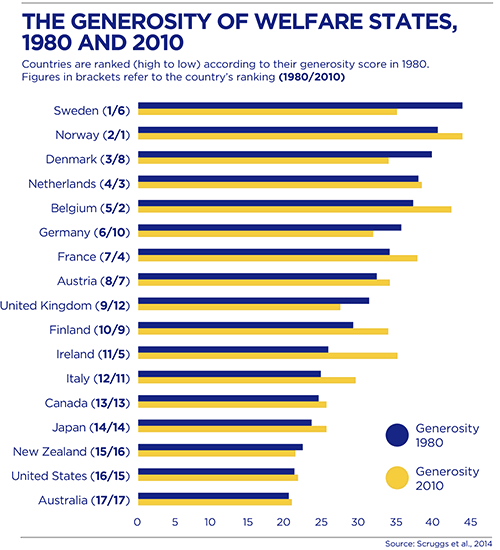
One way of gauging the relative quality of what the welfare state does and how well it does this is past looking at the welfare land'south generosity. Generosity depends on the replacement rates of key social benefits, the duration of such benefits, the kinds of demands people have to meet in club to qualify for a benefit, the number of waiting days included in the rules and how many people are covered by the social scheme. Generosity captures the extent to which social services and benefits have been institutionalized equally social rights that let people to "maintain a livelihood without reliance on the market" (Esping-Andersen 1990, 22).
In chart one, countries are ranked (high to depression) co-ordinate to their generosity alphabetize in 1980. The higher the score on this alphabetize, the more than generous the systems are. Equally can exist seen from the table, in 1980, the Swedish social democratic welfare state was the nigh generous and the Australian liberal welfare country was the nigh tight-fisted. One can besides quite easily recognize Esping-Andersen's classification of welfare states. In 1980, the nigh generous welfare states were the social democratic countries (except Republic of finland), closely followed by the conservative countries. Virtually liberal welfare states (Canada, New Zealand, the United States and Australia) are found at the bottom of nautical chart 1. In 1980, Italy's welfare state looked more than like a liberal than a conservative European welfare model, whereas the liberal Uk was closer to Austria and Germany than to any of the liberal welfare states.
Nautical chart one besides shows that in terms of generosity, the neat picture of the iii worlds of welfare states has become somewhat blurred in 2010. The liberal welfare states have remained quite clearly distinctive in the relatively apprehensive levels of bigheartedness of their welfare states. Interestingly, the U.k. seems to have get much more of a liberal welfare state than information technology used to be, dropping from place ix in 1980 to 12 in 2010. Some of the social autonomous states take become much less generous too. Sweden, the earth's generosity champion in 1980, fell 5 places and ended at rank 6 in 2010, while Denmark descended from place three to 8. 3 continental European countries (Belgium, the netherlands and France) take surpassed the social democratic welfare states (except Kingdom of norway) in generosity in 2010. The biggest change is constitute in Ireland, where the welfare state generosity alphabetize jumps from 25.8 to 35.3, locating this country at place 5, as well above Sweden and Kingdom of denmark. Even though the precise ranking of welfare states and the composition of the models have inverse, it is obvious that there are still clear differences in the quality of welfare states as measured past the generosity index.
Nautical chart 1
The welfare state and income redistribution
The generosity index cannot inform usa precisely about the redistributive features of the welfare states, merely information technology seems reasonable to doubtable that the more than generous systems are besides more than egalitarian. And, indeed, there is a reasonably strong negative correlation between how generous welfare states are and how much inequality they produce (Jensen and Van Kersbergen 2016). The OECD (2014) has published interesting data on how welfare states redistribute and which income groups profit relatively about from social benefits. It turns out that welfare states differ enormously in which income groups they well-nigh privilege. The southern European welfare states transfer a much higher proportion of social benefits to the highest income group than to the lowest one. Portugal leads this group of southern European countries, where the lowest income group receives clearly less than what the pinnacle receives: xi% of all cash benefits goes to the bottom 20% earners, whereas 40% goes to the summit 20%. Portugal too has one of the highest levels of inequality.
There are 2 of import causes for this phenomenon. Kickoff, almost transfers in these countries are simply not meant to help the poor exclusively, but rather are to cover the social risks of all social strata. Second, benefits for the retired, disabled and unemployed are often linked to contribution period and are earnings-related, so that relatively more goes to the well-off than to the poor. This is especially truthful for pensions, and the southern—and some of the continental European—countries are typically pension states: Italy, Greece and Portugal, but also French republic, roughly spend between 13% and 16% of Gdp to pensions, two to three times equally much every bit the social democratic, liberal and some of the conservative welfare states (Switzerland and the Netherlands), which typically spend betwixt 3.6% and 7.4% of GDP on pensions. This means that income redistribution in the pension-heavy welfare states is non from the rich to the poor, just primarily from ane menstruation in life to some other. In other words, inequalities produced during working life are direct reproduced, rather than moderated, in retirement.
This redistributive pattern contrasts sharply with the liberal and social autonomous welfare states, in which the bottom group receives relatively more the elevation. Australia, for case, conspicuously targets the poor every bit over 42% of total benefits goes to the bottom and only 3.8% goes to the peak. However, given that Australia's level of inequality is close to that of Portugal, it is also clear that there is no one-on-1 relationship betwixt the allotment of public benefits to dissimilar income groups and inequality. The main reason is that the relatively high level of transfers to the lesser income group can be an outcome of 2 different things: either a high level of overall spending, as in the Nordic countries, or targeting through means testing (i.e., offering usually minimum benefits exclusively to those who have no other means), every bit is the case in the Anglo-Saxon countries.
Another affair to take into business relationship is that much of the effect of the welfare state on inequality depends on how social benefits and services are financed and allocated. The universalist and comprehensive tax-financed systems that are feature of the social democratic model plough out to be much more redistributive than the targeted systems, even if there is no progressivity in taxation (see Rothstein 1998). In a way, this is counterintuitive considering these welfare states are very generous to the eye grade and do not target the poor. In fact, higher income groups disproportionally profit from social services, peculiarly wellness care and education. Hence, one would expect a fully means-tested organisation, in which a disproportional proportion of benefits goes to the poor, to exist much more redistributive. Withal, means-tested systems tend to be tight-fisted, whereas social autonomous universalist systems distribute much larger sums of money, and equally a outcome, the latter come out as much more redistributive than the more targeted and ways-tested ones, a phenomenon called the paradox of redistribution (Korpi and Palme 1998).
The effect of the welfare land on inequality depends on how social benefits and services are financed and allocated
The redistributive effect of the welfare state tin be directly measured by the percentage difference through transfers and taxes between inequality in market income and inequality of disposable income. Income redistribution is the result of public spending on greenbacks benefits, how much the revenue enhancement-benefit system targets the poor and the progressivity of the tax system. Adema et al. (2014) accept shown that all welfare states redistribute and lower inequality, at to the lowest degree to some extent, only that the cross-national differences in the welfare states' redistributive effects are big, varying from a reject in inequality of 20% to xxx% in the liberal welfare states to 45% to 47% in Ireland, Slovenia, Finland, Belgium and Hungary. Interestingly enough, the countries with the lowest income inequality, namely the social autonomous welfare states of Sweden, Norway, Republic of finland and Denmark, are not among the countries with the peak redistributive tax-do good systems. This, offset of all, reflects the fact that these countries have relatively equal market income distributions in the first place. In addition, the moving-picture show is somewhat distorted because the redistributive impact of the Nordic countries' extensive social services financed via tax are not taken into business relationship (Adema et al. 2014, 19).
Welfare country adaptation and social investment
Welfare states and welfare state models are not static institutions; on the contrary, they are continuously updated and adapted to constantly irresolute social, economical and political circumstances, including shocks, such as the financial crisis and the economical recession that followed in its wake. As documented in more detail elsewhere (Van Kersbergen and Hemerijck 2012; see extensively Hemerijck 2013), all welfare state models have undergone significant changes in the main areas relevant to social policies.
In macroeconomic policy, countries have converged around a policy framework centred on economic stability, hard currencies, depression inflation, sound budgets and debt reduction. The introduction of Economical and Monetary Wedlock turned monetary policy into a fixed parameter for policy reform in other fields. Most countries have also responded to internationalization with wage restraint, usually backed by broad social pacts betwixt employers, unions and the regime. Everywhere, at that place has been a reorientation of labour market policy towards activation with a view to maximize labour market place participation. All welfare states have increased work incentives, although not all have managed to the aforementioned extent to accompany this stick with the carrot of man upper-case letter investment.
Another full general trend has been labour market deregulation, peculiarly decreasing chore protection, in club to make labour markets more flexible and to create opportunities for labour market outsiders. There are, however, large differences between countries in that only some (east.g., Denmark and the Netherlands) complemented the flexibilization of labour markets with measures that extend social protection to vulnerable groups, establishing systems of "flexicurity". More generally, the trend in social insurance has been to focus more on labour market (re-)integration than on income maintenance. Retrenchment of unemployment protection has been part of the flexibility venture near everywhere, although minimum income schemes have been introduced or improved in a number of countries where these were lacking.
Welfare states are continuously updated and adapted to constantly irresolute circumstances, including the financial crisis and the economic recession
Everywhere, reforms have been introduced to make pension systems sustainable under conditions of depression or declining fertility and increasing life expectancy (see European Commission 2015). Measures include increasing the retirement age, limiting early go out, introducing occupational and private pillars on pinnacle of the public schemes and redefining the actuarial links between contributions and benefits. Many countries have also increased their efforts to assist people in their attempts to reconcile work and family, for case, by extending child intendance and pre-school facilities and other services also every bit parental go out provisions.
In Europe, policy reforms in welfare states of diverse kinds have often taken inspiration from the thought of social investment. The basic confidence is that social policies should not only passively compensate for social mishap, only should more proactively be used to prevent labour market inactivity, to adopt a life course perspective (due east.g., life-long learning) and to promote human capital so every bit to stimulate both equality and economic growth. Increasing the chapters of individuals over the life course to remain in employment non merely provides a high level of social security, simply also greatly enhances the long-term financial sustainability of the welfare land. It is in this sense that the term "investment" must be taken quite literally: an investment in human capital will yield swell returns in terms of money saved on passive benefits and money earned from taxes and contributions. Investments in children are particularly promising, considering they help smooth inequalities in (cognitive) abilities and health and prevent an accumulation of disadvantages over the life course, which would otherwise increase demands on passive welfare (Kvist 2015). The social investment strategy hence aims at developing policies that "help to simultaneously widen the tax-base, increase fertility, fight poverty and inequality, or improve the financial sustainability of sure key programmes such every bit alimony schemes" (Morel et al. 2009, 10). The European Commission has promoted social investment as the key policy framework to guide member states in their social policy reforms (European Commission 2013) and to achieve the goals of the Europe 2020 strategy for smart, sustainable and inclusive growth.
The impact of crunch and recession
Before the fiscal crisis hit, social investment was rapidly condign the foundation of a new policy paradigm in most if not all welfare states as well every bit at the European Union level. One ingredient of the social investment strategy, namely employment and activation policies, was adopted everywhere and has helped to increment labour strength participation, especially among women and older men. The economic recession, notwithstanding, has greatly amplified the financial pressure on the welfare country, both by multiplying the number of people on benefits and by decreasing the financial contributions for social policy. Virtually everywhere this has led governments to increase their austerity policy efforts and to retrench on social entitlements so every bit to help rebalance the public upkeep. Fifty-fifty though in discourse the social investment agenda still seems intact, particularly at the European level, it has also become increasingly clear that social investment policies are particularly vulnerable to cuts in the short run, precisely because social investments yield returns only in the longer run, while cost containment is a necessity at present.
Let me take as an example the social democratic welfare states, in which the social investment path has been followed far longer than anywhere else and where it has become an intrinsic component of the welfare land paradigm. If one, for example, compares public expenditures, i finds that the social autonomous welfare states spend 3-4% of GDP more than the conservative, liberal and southern European welfare states on key social investment programmes (educational activity, family benefits and agile labour marketplace programmes). The effects are evident in the use of public services, where the social autonomous welfare states stand up out in the large number of children they enrol in pre-education and children and adults in instruction (schools, training institutions, etc.). The public provision of childcare, educational activity, work-life reconciliation initiatives and active employment policies not only provide people with the skills to work, merely they too free up time to participate in the labour marketplace and generate jobs. As a result, labour market participation rates of men and women are highest in the social democratic welfare states. Finally, as is well known, income inequality and poverty rates are lowest in the social democratic countries.
Contempo trends, however, seem to indicate a modify of management even in the social autonomous social investment arroyo, namely a move away from universalism and inclusive social investment, with ascent selectivity in social policy as an upshot of tighter eligibility criteria, more targeting and privatization. Similarly, focusing on outcomes, there are signs of rise inequality and poverty as an upshot of direct retrenchment and policy drift, that is, not updating social policies to new needs (see Van Kersbergen and Kraft 2016). The signal to stress hither is that if the social democratic welfare states are finding it already increasingly difficult to uphold their allegiance to the social investment oriented welfare state, then information technology is highly likely that other types of welfare states volition find it close to impossible to remain committed to the social investment path they had started to follow before the financial crisis.
The financial meltdown of 2008 and the subsequent recession caused all welfare states to experience similar issues, including rising unemployment, reduced credibility of the banking sector, falling exports and rising budget deficits. Because of the problem similarity, governments initially responded in roughly similar ways. The firsthand response was to massively back up the financial sector and to protect demand by continuing existing social policies and introducing temporary measures to stimulate need. But bailing out banks, recapitalizing them and a host of other measures to save the fiscal sector added upward to a very loftier bill. And on top of that came rising social expenditures and decreasing taxes and contributions, which put public budgets under extreme financial pressure.
The recession caused all welfare states to experience rising unemployment, reduced credibility of the banking sector, falling exports and rising budget deficits
Interestingly enough, the financial crisis of 2008 and the Great Recession that followed in its wake, for obvious reasons, were non blamed on the welfare state, at least not initially. In fact, the welfare state was celebrated for how it cushioned the harmful effects of the crisis every bit its automated stabilizers did exactly what they were meant to do: automatically stabilize demand and protect people from hardship. Merely then something happened, which Mark Blyth (2013) has labelled "the greatest bait and switch in modern history": although the fiscal crisis in European welfare states (except Hellenic republic) was a consequence of the financial crisis, information technology became progressively portrayed as its cause. Because states took responsibility for the massive private debt that banks had caused by socializing it as public debt, the cyberbanking crisis was turned into a sovereign debt crisis, as if it had been the welfare states, rather than the banks, which had acquired the predicament. Thus, the problem became reformulated as one of excessive (welfare) country spending and public debt, which had to be battled by a astringent politics of austerity in order to solve the fiscal crisis and stimulate the economy.
As a result, the political confidence everywhere became that the costly initial response to the crunch and the recession was not sustainable in the long run considering it was causing arrears spending to ascent dramatically. This ushered in a menses of austerity with a view to restore balanced budgets and contain public debt. Governments realized, or in some cases were reminded by the financial markets, that arrears spending had reached its limits. Consequently, the politics of reform increasingly came to revolve around the question of who was to pay for what, when and how. In other words, the event of these political struggles determines who will carry the heavy burden of financial and economical recovery. The crucial political choice nearly everywhere seems to be founded on the conviction that a swift return to a counterbalanced budget is the but sensible road to economic recovery and that drastic retrenchment is the but ways to achieve that goal. Governments have already agreed on pregnant public spending cuts, which add up to desperate reforms that particularly hurt social investment policies and induce new distributional conflicts, although more and then in some countries than in others.
Conclusion
Let me highlight 2 issues by way of a conclusion. On the 1 paw, there has not been a major onslaught against the welfare state in the immediate wake of the financial crisis. On the other hand, at that place have been increasingly desperate spending cuts that seem to undermine the social investment path that welfare states had chosen to follow. During the final twenty twenty years or so, welfare states have been continually adjusting to new economic and social demands, and governments take pursued, albeit with considerable variation, obviously well-adapted and innovative social policies, such as social investment. Merely under increasing stress, especially in the wake of large budget deficits and pressures from financial markets, it is not axiomatic that cadre social programs can be protected through reform; they may become victims of the pending distributional battles or of further policy drift.
Welfare states have been remarkably flexible and capable in their adjustment to their permanently changing environments. Their core social arrangements remain highly popular so that any effort at a radical overhaul continues to meet public resistance. All the same, astringent budgetary problems, the unpredictable but threatening responses of financial markets and the real economic consequences of the financial crunch not only pressure for further reform, merely possibly undermine the political capacity to implement those reforms needed to guarantee the continued protection of people against social risks that the welfare state has then far offered.
BIBLIOGRAPHY
Adema, Willem, Pauline Fron, and Maxime Ladaique. 2014. "How Much Do OECD Countries Spend on Social Protection and How Redistributive Are their Taxation/Benefit Systems?" International Social Security Review 67 (1): ane–25.
Barr, Nicholas. 2001. The Welfare Country as Piggy Bank: Data, Gamble, Uncertainty, and the Office of the Land. Oxford: OUP Oxford.
Barroso, José Manuel Durão. 2012. "State of the Union 2012 Address." European Commission: http://europa.eu/rapid/press-release_SPEECH-12-596_en.htm.
Begg, Iain, Fabian Mushövel, and Robin Niblett. 2015. "The Welfare Land in Europe. Visions for Reform." Chatham Firm Inquiry Paper: https://www.chathamhouse.org/sites/files/chathamhouse/field/field_document/20150917WelfareStateEuropeNiblettBeggMushovel.pdf.
Blyth, Marker. 2013. Austerity: The History of a Unsafe Idea. Oxford: Oxford University Press.
Crozier, Michel, Samuel P. Huntington, and Jöji Watanuki. 1975. The Crisis of Commonwealth: Study on the Governability of Democracies to the Trilateral Commission. New York: New York University Press.
Esping-Andersen, Gøsta. 1990. The Iii Worlds of Welfare Capitalism. Cambridge: Polity Press.
European Commission. 2013. Communication from the Commission to the European Parliament, the Council, the European Economical and Social Committee and the Committee of the Regions, Towards Social Investment for Growth and Cohesion—including implementing the European Social Fund 2014-2020. Brussels: European Commission.
European Committee. 2015. The 2015 Ageing Report: Economic and Budgetary Projections for the 28 Eu Member States (2013–2060). Brussels: European Commission.
Hemerijck, Anton. 2013. Changing Welfare States. Oxford: Oxford University Press.
Hennock, Ernest P. 2007. The Origin of the Welfare State in England and Frg, 1850–1914: Social Policies Compared. Cambridge: Cambridge University Press.
Ipsos MORI. 2014. "Public Perceptions of the NHS and Social Care Tracker Survey Winter 2013 Wave." https://www.ipsos-mori.com/Assets/Docs/sri-wellness-nhstracker-report-winter2013.pdf
Jensen, Carsten, and Kees van Kersbergen, forthcoming in 2016. The Politics of Inequality. Houndmills: Palgrave Macmillan.
Korpi, Walter, and Joakim Palme. 1998. "The Paradox of Redistribution and Strategies of Equality: Welfare State Institutions, Inequality, and Poverty in the Western Countries." American Sociological Review 63 (5): 661–687.
Kuhnle, Stein, and Anne Sander. 2010. "The Emergence of the Welfare State." In The Oxford Handbook of the Welfare State, edited past Francis C. Castles, Stephan Leibfried, Jane Lewis, Herbert Obinger, and Christopher Pierson, 61-eighty. Oxford: Oxford University Printing.
Kvist, Jon. 2015. "A Framework for Social Investment Strategies: Integrating Generational, Life Form and Gender Perspectives in the EU Social Investment Strategy." Comparative European Politics 13, 131–149.
Levell Peter, Barra Roantree, and Jonathan Shaw. 2015. "Redistribution from a Lifetime Perspective." Institute for Fiscal Studies Working Paper W15/27, http://www.ifs.org.uk/uploads/publications/wps/WP201527.pdf.
Morel, Nathalie, Bruno Palier, and Joakim Palme. eds. 2012. What Future for Social Investment? Stockholm: Institute for Futures Studies.
OECD (2013), Social Expenditure (SOCX), world wide web.oecd.org/social/expenditure.htm.
OECD (2014), Social Expenditure Update, Paris: OECD.
Petmesidou, Maria, and Ana Guillén. 2015. "Economic crisis and Austerity in Southern Europe: Threat or Opportunity for a Sustainable Welfare State?" OSE Research Paper.Polanyi, Karl. 1944 (1957). The Great Transformation: The Political and Economic Origins of Our Fourth dimension. Boston, MA: Buoy Press.
Quigley, Anna. 2014. "Maintaining Pride in the NHS: The Challenge for the New NHS Primary Exec." https://www.ipsos-mori.com/newsevents/blogs/makingsenseofsociety/1553/Maintaining-pride-in-the-NHS-The-challenge-for-the-new-NHS-Master-Exec.aspx#gallery[m]/0/
Rothstein, Bo. 1998. Simply Institutions Thing: The Moral and Political Logic of the Universal Welfare State. Cambridge: Cambridge University Press.
Scruggs, Lyle, Detlef Jahn, and Kati Kuitto. 2014. Comparative Welfare Entitlements Dataset two. Version 2014-03. Academy of Connecticut and University of Greifswald.
Starke, Peter, Alexandra Kaasch, and Franca Van Hooren. 2013. The Welfare Land as Crunch Manager. Explaining the Diversity of Policy Responses to Economical Crisis. Houndmills: Palgrave Macmillan.
Van der Wel, Kjetil A., and Knut Halvorsen. 2015 "The Bigger the Worse? A Comparative Written report of the Welfare State and Employment Commitment." Work, Employment and Society 29 (1): 99–118.
Van Kersbergen, Kees, and Anton Hemerijck. 2012. "2 Decades of Change in Europe: The Emergence of the Social Investment Country." Journal of Social Policy 41 (3): 475–492.
Van Kersbergen, Kees, and Barbara Vis. 2014. Comparative Welfare State Politics. Development, Opportunities, and Reform. Cambridge: Cambridge University Press.
Van Kersbergen, Kees, and Jonas Kraft, forthcoming in 2016. "De-universalization and Selective Social Investment in Scandinavia?" In The Uses of Social Investment, edited by Anton Hemerijck. Oxford: Oxford University Printing.
Source: https://www.bbvaopenmind.com/en/articles/the-welfare-state-in-europe/
Belum ada Komentar untuk "Book Review Family Life and Individual Welfare in Post-war Europe : Britain and Italy Compared"
Posting Komentar